


Plate Rolling — How to Choose the Right Machine
Read More
Read MoreThe Morgan Rushworth HSR-3 range of hydraulic section bending machines are designed to roll various material sections and are available with shaft diameters from 50mm up to 120mm. All models have twin rams powering both of the lower rolls, providing pre bending capability and the convenience of performing the bending operation with the material in the horizontal position. All of the HSR-3 machines can be operated in either vertical or horizontal plane. The standard rolls supplied with the machine are hardened and have been designed to bend most sections, avoiding the cost of additional tooling. Lateral guide rolls ensure straight and true bending, or if required can be adjusted in order to spiral the material.

| Model | HSR-3 40.140 | |
| Flat Bar on Edge at 300mm Ø | mm | 35 x 8 |
| Flat Bar as Flat at 400mm Ø | mm | 50 x 12 |
| Square Bar at 250mm Ø | mm | 18 |
| Round Bar at 200mm Ø | mm | 22 |
| Round Tube at 500mm Ø * | mm | 40 x 1.5 |
| Round Pipe at 200mm Ø * | mm | 33.7 x 2.3 |
| Rectangular Hollow Section at 500mm Ø | mm | 30 x 15 x 2.5 |
| Square Hollow Section at 450mm Ø | mm | 25 x 25 x 2 |
| Angle Iron Toe Out at 400mm Ø | mm | 35 x 35 x 5 |
| Angle Iron Toe In at 550mm Ø | mm | 30 x 30 x 4 |
| Tee Section Toe Out at 300mm Ø | mm | 30 x 30 x 5 |
| Tee Section Toe In at 350mm Ø | mm | 35 x 35 x 5 |
| Tee Section Toe Up/Down at 300mm Ø | mm | 35 x 35 x 5 |
| Channel Legs Out at 350mm Ø | mm | 40 x 20 x 5 |
| Channel Legs In at 500mm Ø | mm | 35 x 18 x 5 |
| Power | kW | 1.1 |
| Rolls Diameter | mm | 137 |
| Shafts Diameter | mm |
35 |
| Bending Speed | m/min | 7 |
| Length | mm | 1050 |
| Width | mm | 500 |
| Height | mm | 1250 |
| Weight | kg | 350 |
| * With optional special rolls |
Read More
Read More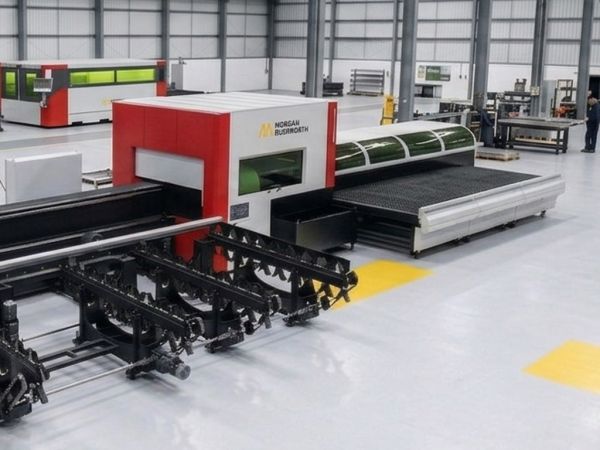
In modern metal manufacturering, staying competitive requires balancing speed, precision, and operational efficiency. Traditional tube processing methods, such as sawing, drilling, punching, and manual deburring, are notoriously labor-intensive and prone to human error. Each additional handling stage introduces potential for delay, increased costs, and inconsistency.
Read More
Read More
UK defence spending is rising at a pace not seen since the Cold War, and for metal fabricators with the right capabilities, that represents a significant commercial opportunity. Understanding where the demand is coming from, and what it means for workshop investment, is worth the attention of any fabrication business looking to grow.
Read More
Read More
In recent years, the Health and Safety Executive (HSE) has placed welding fumes under closer scrutiny, with scientific evidence linking exposure to a range of health issues, including lung cancer, neurological disorders, and asthma. Employers have a duty to provide a safe and healthy working environment for their staff, which includes putting effective controls in place to manage exposure to welding fumes — general ventilation on its own is not enough to adequately mitigate the risks. Although welders themselves may be adequately protected by PPE, the HSE has placed particular emphasis on other employees who share the same workspace.
Read More
Read MoreEnquire About: "Morgan Rushworth HSR-3 40.140 Hydraulic Section Ring Rolling Machine"