

Unlocking Efficiency & Precision: Why UK Manufacturers Are Moving to Tube Laser Cutting
- 11-08-2026
- Matthew Denny
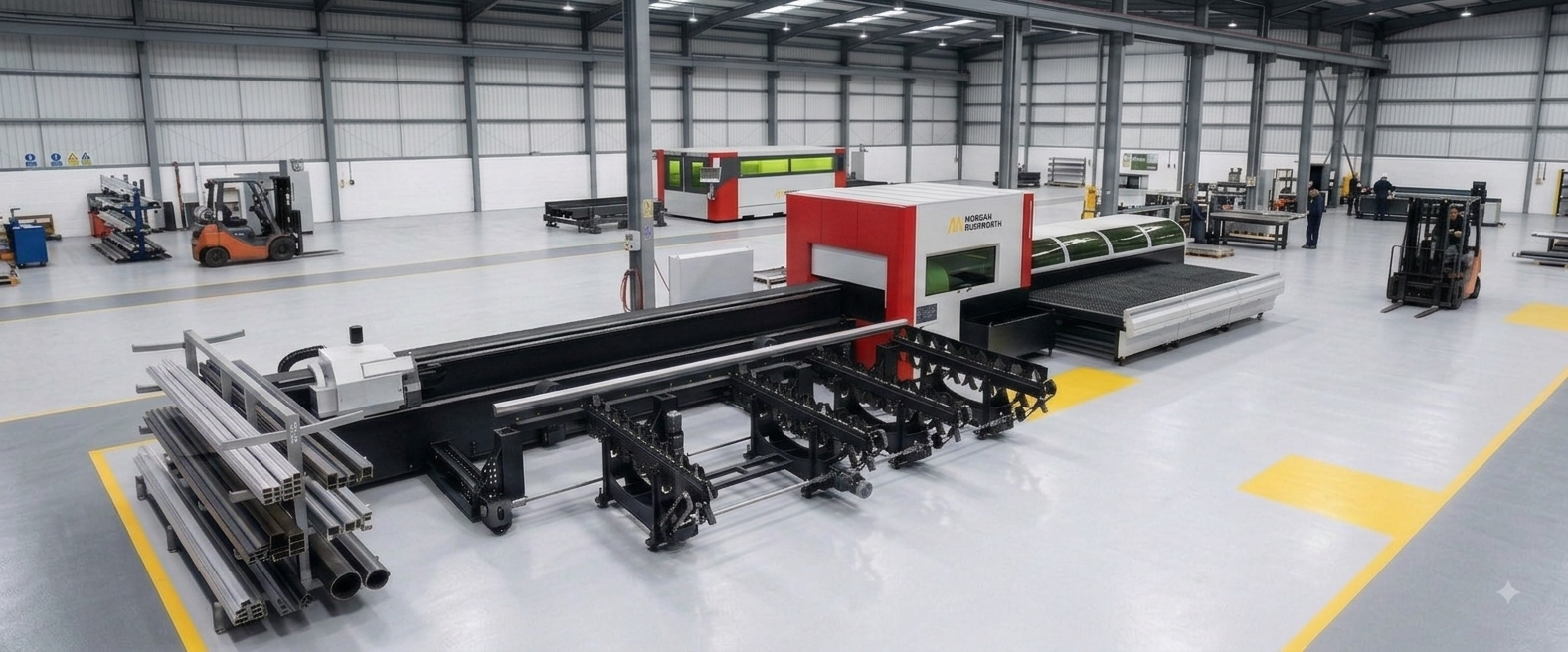
In modern metal manufacturing, staying competitive requires balancing speed, precision, and operational efficiency. Traditional tube processing methods—such as sawing, drilling, punching, and manual deburring—are notoriously labor-intensive and prone to human error. Each additional handling stage introduces potential for delay, increased costs, and inconsistency.
Enter Tube Laser Cutting Technology—a single-process solution that is transforming structural steel, box section, and tubular component manufacturing.
1. Replacing Multiple Processes with One Machine
The most immediate advantage of a dedicated tube laser is process consolidation. Instead of cutting a profile to length on a bandsaw, moving it to a drill press, and then milling or notch-cutting, a tube laser executes all of these steps in a single automated operation:
- Straight & Angle Cutting to exact length.
- Hole Punching & Slotting with zero tool wear.
- Complex Profiling & Mitres, including interlocking tabs and slots that simplify downstream assembly and welding.
By eliminating intermediate handling, manufacturers cut lead times drastically while freeing up valuable shop-floor labor.
2. Unmatched Accuracy and Repeatability
Laser cutting offers micro-level precision that traditional mechanical methods simply cannot match. With CNC computer control, tube lasers produce tight tolerances across long lengths, ensuring every cut, hole, and notch aligns perfectly.
This high degree of repeatability is particularly critical for structural components, framework fabrication, and sub-assemblies. When parts fit together seamlessly on the welding bench, downstream assembly times drop significantly.
3. Design Freedom & Complex Geometry
Traditional tooling places rigid limits on design—cutting tight curves or intricate patterns into round or box sections often required custom dies or painstaking hand finishing.
With fiber laser technology, complex geometry costs no more to cut than a straight line. Engineers and manufacturers can design self-locating joints, saddle cuts, and complex cutouts directly into the CAD model, unlocking new possibilities in product design across architectural metalwork, automotive, agricultural machinery, and general fabrication.
4. Reduced Material Waste & Lower Operating Costs
Tube laser technology utilizes advanced nesting software to optimize component layout along each length of stock, keeping scrap rates to an absolute minimum. Furthermore, non-contact fiber laser processing means zero mechanical tool wear, reducing maintenance downtime and consumable overheads compared to traditional saws and punch tooling.
Explore the Morgan Rushworth Profiling Range at Bison
At Bison Machinery, we offer high-performance laser machinery tailored to the needs of UK manufacturers:
- Morgan Rushworth XTR Tube Laser Cutting Machines - Specifically engineered for rapid, high-precision processing of round, square, rectangular, and open profiles. The XTR series brings complete automation, versatile chucking systems, and powerful fiber laser sources to modern tubular manufacturing workshops.
- Morgan Rushworth XTC Fibre Laser Cutting Machines - For workshops looking to handle flat sheet profiling alongside structural tubular sections, the XTC series provides exceptional sheet metal cutting capabilities with optional combination tube-cutting attachments.
Ready to Upgrade Your Workshop's Tube Processing Capabilities?
Whether you are looking to bring outsourced tube laser work back in-house or replace aging mechanical machinery, our technical sales team can guide you through machine selection, ROI calculations, and live demonstrations.
- Call us: 01785 214242
- Email: sales@bisonmachinery.co.uk
- Visit our Showroom: St Albans Road, Stafford, ST16 3DR
