


Plate Rolling — How to Choose the Right Machine
Read More
Read MoreThe Antil APR Press Brake Bending Robots are a versatile solution for automating bending production utilising either a new or existing press brake. Automating press brakes with an APR robot is a highly effective way of increasing productivity without limiting bending capabilities. These models offer serious advantages over traditional robot formats, being easy to program and operate, and with the gantry design, removing common limitations in handling the material. Significantly the APR robot does not require a dedicated press brake but can be parked to one side, allowing use in manual mode for single pieces or small batch work. When a production run is required the robot can be set to run automatically; either during the day or often at the end of a shift for full ‘lights out’ operation. As well as improving productivity the APR is also used for bending large, awkward components which would normally need two operators to handle; this brings immediate benefits in both cost savings and operator safety.
.jpg)
| MODEL | APR 80-10 | |
| Maximum Component Dimension | mm | 3500 |
| Weight at Wrist | kg | 80 |
| Torque at Rotation Centre | kgm | 24 |
| X Axis Travel | m | 10 |
| Y Axis Travel | mm | 2320 |
| Z Axis Travel | mm | 1645 |
| Working Height under the Sliding Support | mm | 2650 |
Read More
Read More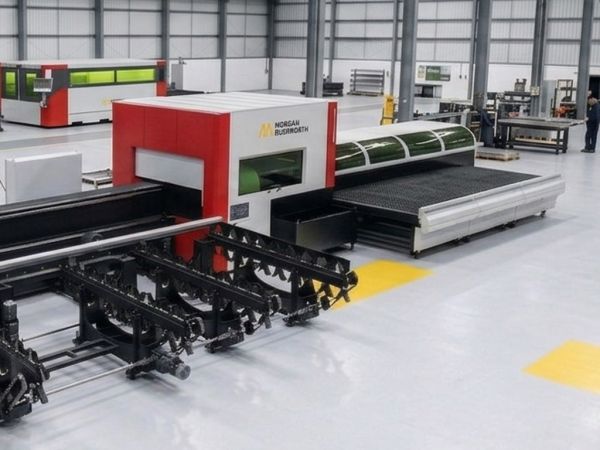
In modern metal manufacturering, staying competitive requires balancing speed, precision, and operational efficiency. Traditional tube processing methods, such as sawing, drilling, punching, and manual deburring, are notoriously labor-intensive and prone to human error. Each additional handling stage introduces potential for delay, increased costs, and inconsistency.
Read More
Read More
UK defence spending is rising at a pace not seen since the Cold War, and for metal fabricators with the right capabilities, that represents a significant commercial opportunity. Understanding where the demand is coming from, and what it means for workshop investment, is worth the attention of any fabrication business looking to grow.
Read More
Read More
In recent years, the Health and Safety Executive (HSE) has placed welding fumes under closer scrutiny, with scientific evidence linking exposure to a range of health issues, including lung cancer, neurological disorders, and asthma. Employers have a duty to provide a safe and healthy working environment for their staff, which includes putting effective controls in place to manage exposure to welding fumes — general ventilation on its own is not enough to adequately mitigate the risks. Although welders themselves may be adequately protected by PPE, the HSE has placed particular emphasis on other employees who share the same workspace.
Read More
Read MoreEnquire About: "Antil APR 80-10 Press Brake Bending Robot"