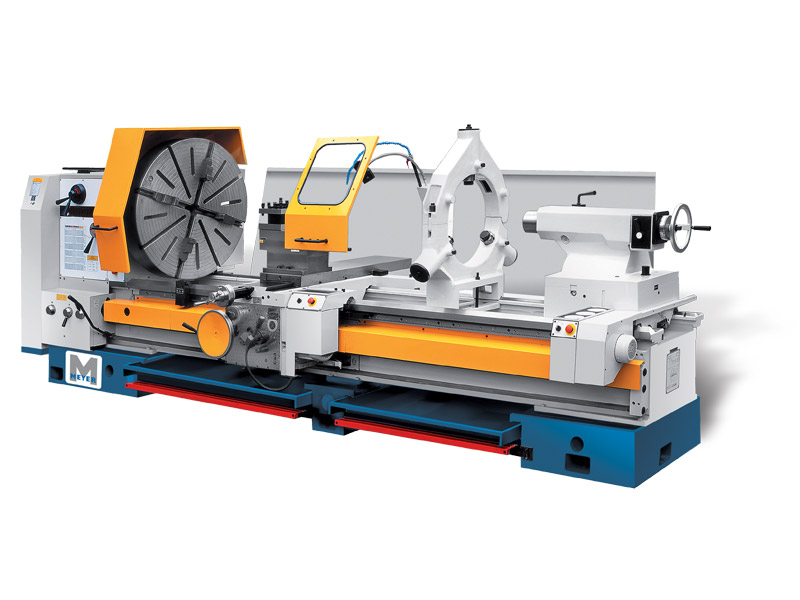
Meyer Euroline EX 660/1500 Precision Centre Lathe

The Meyer Euro Line range continues with the high capacity EV, EX & EC models, featuring wider bed designs and high powered motors.  The EX range includes the EX 1410 model with the 1410mm swing over bed and, by special request, up to 9000mm distance between centres.  The EC models offer a very large bore through the headstock and can be offereed with additional free standing steadies for working with longer material lenghts.  All models can be offered in a variable speed version as well as with a wide range of optional features and accessories.  As with the smaller models, these machines offer thread cutting in a large range of types and pitches.

Meyer Euroline EX 660/1500 Precision Centre Lathe
Download PDF Spec Sheet Meyer Euroline EX 660/1500 Precision Centre Lathe Download PDF Spec Sheet

Download
PDF Spec Sheet

Read More Meyer Euroline EX 660/1500 Precision Centre Lathe Read More

Read
More

Get In Touch Get In Touch

Get In
Touch

Features

  • High quality European built machines 
  • Rigid build ensures high chip removal rate during the rough turning operation
  • Highly resistant steel with high loading capacity used for all gear and spindle parts
  • Cast bed with hardened and ground bed ways
  • Gap bed design
  • Variable spindle speed
  • Rapid traverse
  • Four position square toolpost
  • Chuck guard with interlock switch
  • Lead screw guard
  • Low voltage halogen work light
  • Centralised lubrication
  • Chip collection tray
  • Coolant system
  • Full length rear splash guard

Options

  • Variable spindle speed
  • 2 or 3 axis digital read out
  • Thread dial indicator
  • Quick change tool post
  • 3 and 4 jaw chucks
  • Face plate
  • Fixed steady
  • Follow rest

Technical Information

Capacities    
Height of Centres mm 330
Swing over Bed mm 660
Swing over Cross Slide mm 420
Swing in Gap mm 850
Width of Bed mm 560
Distance between Centres mm 1500
Headstock    
Spindle Nose (DIN55027) No 11
Spindle Bore mm 103
Spindle Taper Metric 120
Number of Spindle Speeds No 15
Spindle Speed Range RPM 9 - 1320
Variable Spindle Speed Range (Optional) RPM 9 - 1320
Main Motor Power kW 11
Feed Rates    
Number of Feeds No 150
Longitudinal Feed Range mm/rev 0.039- 18
Cross Feed Range mm/rev 0.02 - 9
Threads    
Metric Thread Range/No of Steps mm 0.5 - 180
Imperial Thread Range/No of Steps TPI 60 - 1/6
Module Thread Range/No of Steps Module 0.125 - 45
DP Thread Range/No of Steps DP 240 - 2/3
Carraige    
Cross Slide Travel mm 410
Top Slide Travel mm 150
Tailstock    
Quill Diameter mm 105
Quill Taper MT 6
Quill Travel mm 225
Dimensions    
Length mm 3790
Width mm 1600
Height mm 1750
Weight kg 3980
Plate Rolling — How to Choose the Right Machine

Plate Rolling — How to Choose the Right Machine

Read More

Read More
Unlocking Efficiency & Precision: Why UK Manufacturers Are Moving to Tube Laser Cutting

Unlocking Efficiency & Precision: Why UK Manufacturers Are Moving to Tube Laser Cutting

In modern metal manufacturering, staying competitive requires balancing speed, precision, and operational efficiency. Traditional tube processing methods, such as sawing, drilling, punching, and manual deburring, are notoriously labor-intensive and prone to human error. Each additional handling stage introduces potential for delay, increased costs, and inconsistency.

Read More

Read More
The Impact of the Defence Sector on UK Metal Fabrication Demand

The Impact of the Defence Sector on UK Metal Fabrication Demand

UK defence spending is rising at a pace not seen since the Cold War, and for metal fabricators with the right capabilities, that represents a significant commercial opportunity. Understanding where the demand is coming from, and what it means for workshop investment, is worth the attention of any fabrication business looking to grow.

Read More

Read More
A unique solution for welding fume extraction

A unique solution for welding fume extraction

In recent years, the Health and Safety Executive (HSE) has placed welding fumes under closer scrutiny, with scientific evidence linking exposure to a range of health issues, including lung cancer, neurological disorders, and asthma. Employers have a duty to provide a safe and healthy working environment for their staff, which includes putting effective controls in place to manage exposure to welding fumes — general ventilation on its own is not enough to adequately mitigate the risks. Although welders themselves may be adequately protected by PPE, the HSE has placed particular emphasis on other employees who share the same workspace.

Read More

Read More