


Plate Rolling — How to Choose the Right Machine
Read More
Read MoreThe Meyer Euro Line range of precision centre lathes are of robust construction and are designed and manufactured in Europe using high quality materials and with stringent quality control procedures. The ER and ES models span a range from a small tool room lathe with 325mm swing over bed and 500mm between centres, up to 600mm swing over bed with 5 metres between centres. All models come with thread cutting as standard in a large range of metric, imperial, module and diametric pitches. Many models can be supplied with an optional infinitely variable speed configuration with a number of sub ranges.

| Capacities | ||
| Height of Centres | mm | 250 |
| Swing over Bed | mm | 500 |
| Swing over Cross Slide | mm | 300 |
| Swing in Gap | mm | 700 |
| Width of Bed | mm | 400 |
| Distance between Centres | mm | 3000 |
| Headstock | ||
| Spindle Nose (DIN55027) | No | 8 |
| Spindle Bore | mm | 72 |
| Spindle Taper | Metric | 80 |
| Number of Spindle Speeds | No | 21 |
| Spindle Speed Range | RPM | 20 - 2000 |
| Variable Spindle Speed Range (Optional) | RPM | 25 - 2000 |
| Main Motor Power | kW | 7.5 |
| Feed Rates | ||
| Number of Feeds | No | 120 |
| Longitudinal Feed Range | mm/rev | 0.04 - 12 |
| Cross Feed Range | mm/rev | 0.02 - 6 |
| Threads | ||
| Metric Thread Range/No of Steps | mm | 0.5 - 120 |
| Imperial Thread Range/No of Steps | TPI | 60 - 1/4 |
| Module Thread Range/No of Steps | Module | 0.125 - 30 |
| DP Thread Range/No of Steps | DP | 240 - 1 |
| Carraige | ||
| Cross Slide Travel | mm | 315 |
| Top Slide Travel | mm | 130 |
| Tailstock | ||
| Quill Diameter | mm | 90 |
| Quill Taper | MT | 5 |
| Quill Travel | mm | 230 |
| Dimensions | ||
| Length | mm | 4900 |
| Width | mm | 1100 |
| Height | mm | 1700 |
| Weight | kg | 3470 |
Read More
Read More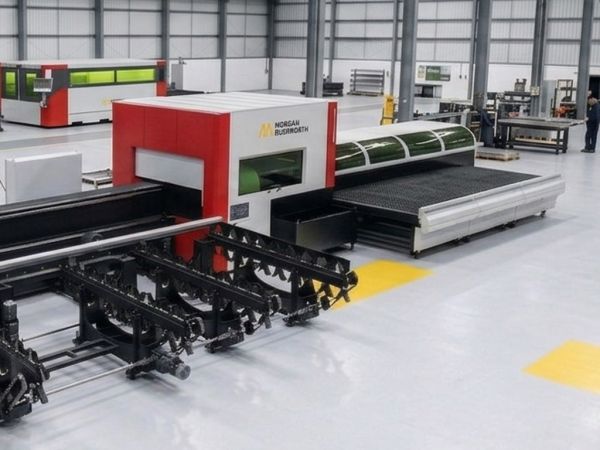
In modern metal manufacturering, staying competitive requires balancing speed, precision, and operational efficiency. Traditional tube processing methods, such as sawing, drilling, punching, and manual deburring, are notoriously labor-intensive and prone to human error. Each additional handling stage introduces potential for delay, increased costs, and inconsistency.
Read More
Read More
UK defence spending is rising at a pace not seen since the Cold War, and for metal fabricators with the right capabilities, that represents a significant commercial opportunity. Understanding where the demand is coming from, and what it means for workshop investment, is worth the attention of any fabrication business looking to grow.
Read More
Read More
In recent years, the Health and Safety Executive (HSE) has placed welding fumes under closer scrutiny, with scientific evidence linking exposure to a range of health issues, including lung cancer, neurological disorders, and asthma. Employers have a duty to provide a safe and healthy working environment for their staff, which includes putting effective controls in place to manage exposure to welding fumes — general ventilation on its own is not enough to adequately mitigate the risks. Although welders themselves may be adequately protected by PPE, the HSE has placed particular emphasis on other employees who share the same workspace.
Read More
Read MoreEnquire About: "Meyer Euroline ES 500/3000 Precision Centre Lathe"