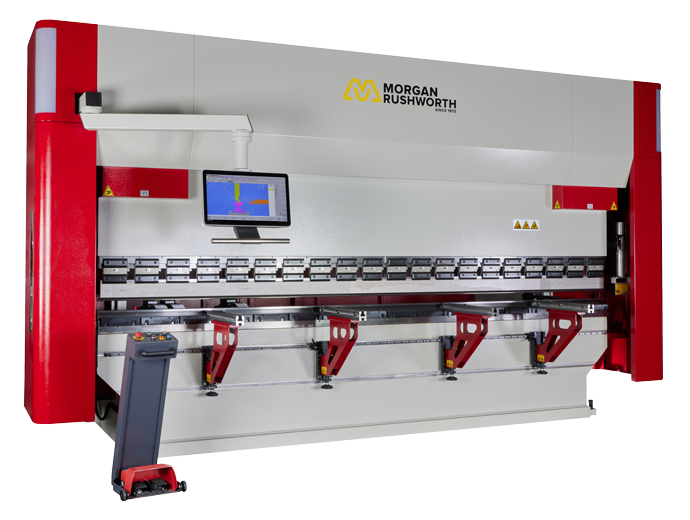
Morgan Rushworth PBXS CNC 6100.240 Hydraulic Press Brake

The Morgan Rushworth PBXS CNC press brakes are fitted with the ESA VIS-875W CNC control featuring a 21” touch screen and both numerical and 2D graphical program entry. Bending can also be graphically visualised in 2D or 3D showing the machine frame, top and bottom tools, back gauge fingers and part orientation. PC based software is included and, with the control networked, can be used to load programs from the office. The PBXS CNC models feature 5 axis CNC control of the left and right ram cylinders, the back gauge depth, back gauge height and the bottom tool crowning system. The position of the two cylinders is fully synchronised with high precision scales on the side frames ensuring ram parallelism. These machines follow a rigorous design and manufacturing process to ensure minimum deflection of the machine frame under maximum working pressure. AKAS laser tooling guards are standard and offer a vastly improved operator experience without compromising safety.

All PBXS CNC models are supplied with sectionalised euro style top tools and a multi vee bottom die. The range covers models from 40 tonnes through to 1000 tonnes capacity with bending lengths from 1250mm up to 8100mm in the standard design. Special models can be built with larger widths and higher tonnages or for use as tandem machines. A comprehensive range of options are available to fully tailor the machine to requirements including 6-axis or 8-axis configurations.

Morgan Rushworth PBXS CNC 6100.240 Hydraulic Press Brake
Download PDF Spec Sheet Morgan Rushworth PBXS CNC 6100.240 Hydraulic Press Brake Download PDF Spec Sheet

Download
PDF Spec Sheet

Read More Morgan Rushworth PBXS CNC 6100.240 Hydraulic Press Brake Read More

Read
More

Get In Touch Get In Touch

Get In
Touch

Features

  • ESA VIS-875W multi-axis CNC control with numerical and 2D graphical programming and 2D or 3D visualisation, mounted on pendant arm
  • Fully synchronised CNC control of left and right upper beam cylinder position – Y1 + Y2 axis
  • CNC control of back gauge depth – X axis
  • CNC control of back gauge height – R axis
  • CNC bottom tool crowning system - A axis
  • Manual side to side movement of back gauge fingers – Z axis
  • Quick release top tool clamping system
  • Euro style top tool holders with intermediates including wedges for crowning
  • Sectionalised goose neck top tool and multi vee bottom die
  • Bottom tool wedge crowning system
  • AKAS laser tooling guards for enhanced ease of use
  • Strong rigid welded mono block frame able to withstand deflection under maximum load
  • High precision linear scales for measurement of the stroke depth which are mounted on the side frames rather than the top beam to prevent any inaccuracy through distortion as the beam comes under load
  • Hydraulic ram travel guided in low friction slide ways
  • Large open height and generous ram stroke
  • Deep reinforced throat in side frames
  • High approach and return speeds for production bending
  • Front support arms with flip stop, adjustable on a linear rail
  • Dual foot switch console with emergency stop
  • Electrically interlocked side guards
  • Electrically interlocked rear access door

Options

  • Optional offline ESA Bend 3D Software with Control Viewer
  • Independent CNC control of side to side movement of back gauge fingers – Z1 + Z2 axis
  • Independent CNC tower back gauge system – X1 + R1 + Z1, X2 + R2 + Z2
  • Laser angle measurement system with live feedback to CNC control
  • Manual bottom tool crowning system with position counter
  • Hydraulic top and bottom tool clamping system
  • Additional back gauge fingers
  • Additional front support arms
  • Brush table for front support arms
  • CNC sheet follower support arms
  • Parking area for sheet follower support arms – one per side

Technical Information

MODEL   PBXS CNC 6100.240
Bending Power tonne 240
Bending Length (Over Tooling) mm 6100
Bending Length (Between Frames) mm 5100
Y Axis Approach Speed mm/sec 140
Y Axis Bending Speed (Maximum) mm/sec 10
Y Axis Return Speed mm/sec 100
X Axis Travel mm 750
X Axis Speed mm/sec 330
R Axis Travel mm 160
R Axis Speed mm/sec 240
No of Back Gauge Fingers   4
No of Sheet Support Arms   4
Stroke mm 260
Daylight mm 500
Throat Depth mm 500
Table Height mm 1100
Table Width mm 90
Oil Capacity litre 300
Motor Power kW 22
Nominal Power (excluding options) kW 26
Length mm 7000
Width mm 2255
Height mm 3090
Weight kg 25500
Plate Rolling & How to Choose the Right Machine

Plate Rolling & How to Choose the Right Machine

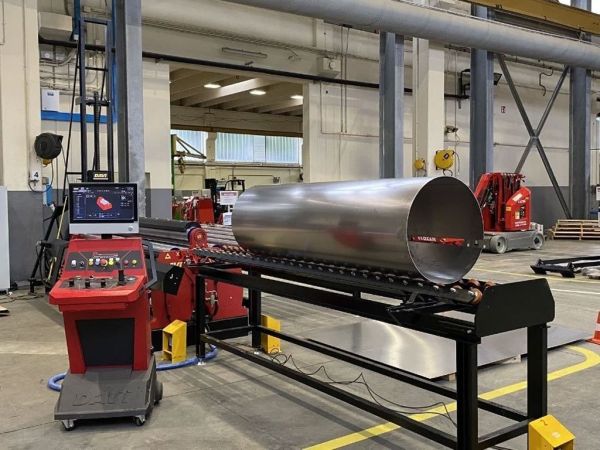
Plate rolling may look like a straightforward processes until you're standing in front of the a machine that is unsuitable for the task. This guide cuts through the options so you can make the right choice for your specific operation.

Read More

Read More
Unlocking Efficiency & Precision: Why UK Manufacturers Are Moving to Tube Laser Cutting

Unlocking Efficiency & Precision: Why UK Manufacturers Are Moving to Tube Laser Cutting

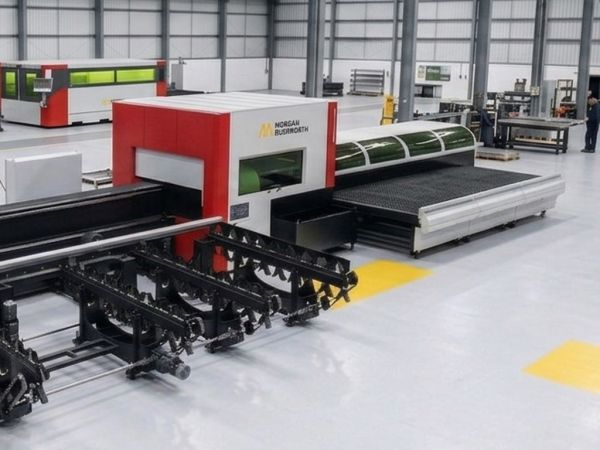
In modern metal manufacturing, staying competitive requires balancing speed, precision, and operational efficiency. Traditional tube processing methods, such as sawing, drilling, punching, and manual deburring, are notoriously labor-intensive and prone to human error. Each additional handling stage introduces potential for delay, increased costs, and inconsistency.

Read More

Read More
The Impact of the Defence Sector on UK Metal Fabrication Demand

The Impact of the Defence Sector on UK Metal Fabrication Demand

UK defence spending is rising at a pace not seen since the Cold War, and for metal fabricators with the right capabilities, that represents a significant commercial opportunity. Understanding where the demand is coming from, and what it means for workshop investment, is worth the attention of any fabrication business looking to grow.

Read More

Read More
Welding Fume Extraction: Improving Safety, Compliance and Productivity

Welding Fume Extraction: Improving Safety, Compliance and Productivity

In recent years, the Health and Safety Executive (HSE) has placed welding fumes under closer scrutiny, with scientific evidence linking exposure to a range of health issues, including lung cancer, neurological disorders, and asthma. Employers have a duty to provide a safe and healthy working environment for their staff, which includes putting effective controls in place to manage exposure to welding fumes — general ventilation on its own is not enough to adequately mitigate the risks. Although welders themselves may be adequately protected by PPE, the HSE has placed particular emphasis on other employees who share the same workspace.

Read More

Read More