Sterling STC650 DGSA NC Twin Column Double Mitre Semi-Automatic Band Saw

The Sterling STC650 DGSA NC is an extremely high specification model with advanced features including NC controlled powered bow rotation for mitre angle setting. With the capacity to cut up to 1000mm beams at 90 degrees, this machine is ideally suited to large structural applications.

Sterling STC650 DGSA NC Twin Column Double Mitre Semi-Automatic Band Saw
Download PDF Spec Sheet Sterling STC650 DGSA NC Twin Column Double Mitre Semi-Automatic Band Saw Download PDF Spec Sheet

Download
PDF Spec Sheet

Read More Sterling STC650 DGSA NC Twin Column Double Mitre Semi-Automatic Band Saw Read More

Read
More

Get In Touch Get In Touch

Get In
Touch

Features

  • Twin column design with linear guides
  • Hydraulic downfeed with variable cutting pressure
  • 5 degree inclined blade
  • Hydraulic bow return with height adjustment
  • Double mitring swivel head 45° left and 60° right
  • Powered bow rotation with NC controlled angle setting
  • Digital mitre display
  • Hydraulic bow lock at any angle
  • Hydraulic vice able to clamp at any angle
  • Carbide blade guides for high accuracy
  • Hydraulic blade tension
  • Infinitely variable cutting speed
  • Motorised swarf brush
  • Chip conveyor
  • Coolant system
  • Safety interlock switches fitted to band cover

Options

  • Hydraulic top vice clamp
  • Laser cutting line
  • Spray mist cooling system (requires compressor)
  • Roller track and measuring systems

Technical Information

MODEL   STC650 DGSA NC
Capacities    
Tube at 90° mm 650
Square Section at 90° mm 600
Rectangular Section / Beam at 90° mm 1000 x 600
Tube at 45° L & R mm 650
Square Section at 45° L & R mm 600
Rectangular Section / Beam at 45° L & R mm 650 x 600
Tube at 60° L & R mm 440
Square Section at 60° L & R mm 440
Rectangular Section / Beam at 60° L & R mm 440 x 600
Blade Size mm 8400 x 54 x 1.6
Bed Height mm 880
Cutting Speed m/min 20 - 100
Motor kW 7.5
Length mm 4660
Width mm 1730
Height mm 2630
Weight Kg 6000
Operation   Semi-automatic
Vice   Hydraulic
Plate Rolling & How to Choose the Right Machine

Plate Rolling & How to Choose the Right Machine

Plate rolling may look like a straightforward processes until you're standing in front of the a machine that is unsuitable for the task. This guide cuts through the options so you can make the right choice for your specific operation.

Read More

Read More
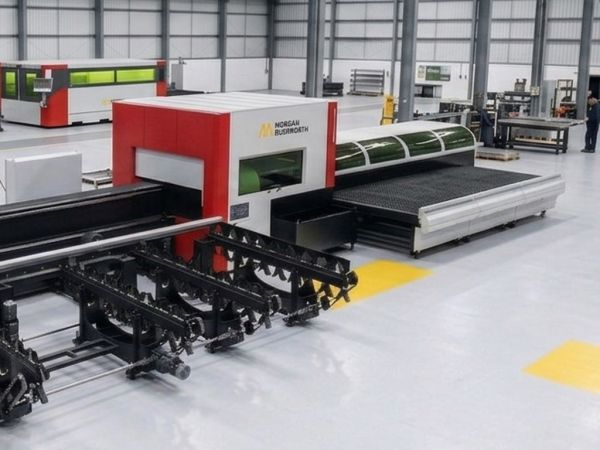

Unlocking Efficiency & Precision: Why UK Manufacturers Are Moving to Tube Laser Cutting

Unlocking Efficiency & Precision: Why UK Manufacturers Are Moving to Tube Laser Cutting

In modern metal manufacturing, staying competitive requires balancing speed, precision, and operational efficiency. Traditional tube processing methods, such as sawing, drilling, punching, and manual deburring, are notoriously labor-intensive and prone to human error. Each additional handling stage introduces potential for delay, increased costs, and inconsistency.

Read More

Read More
The Impact of the Defence Sector on UK Metal Fabrication Demand

The Impact of the Defence Sector on UK Metal Fabrication Demand

UK defence spending is rising at a pace not seen since the Cold War, and for metal fabricators with the right capabilities, that represents a significant commercial opportunity. Understanding where the demand is coming from, and what it means for workshop investment, is worth the attention of any fabrication business looking to grow.

Read More

Read More
Welding Fume Extraction: Improving Safety, Compliance and Productivity

Welding Fume Extraction: Improving Safety, Compliance and Productivity

In recent years, the Health and Safety Executive (HSE) has placed welding fumes under closer scrutiny, with scientific evidence linking exposure to a range of health issues, including lung cancer, neurological disorders, and asthma. Employers have a duty to provide a safe and healthy working environment for their staff, which includes putting effective controls in place to manage exposure to welding fumes — general ventilation on its own is not enough to adequately mitigate the risks. Although welders themselves may be adequately protected by PPE, the HSE has placed particular emphasis on other employees who share the same workspace.

Read More

Read More