

Carbon Footprint Reduction for UK Metal Fabricators: Where to Start
- 28-05-2026
- Matthew Denny
Net zero isn't just a government target, it's increasingly a commercial reality. More and more UK manufacturers are being asked by their customers to demonstrate their environmental credentials, and fabrication businesses that can't answer that question are starting to lose work to those that can.
The good news is that reducing your carbon footprint doesn't have to mean a wholesale reinvention of your business. For most fabrication shops, the biggest gains come from a handful of well-chosen changes; many of which pay back in reduced energy costs long before any green dividend kicks in.
Here's where to focus.
1. Start With an Energy Audit
You can't manage what you don't measure. An energy audit maps exactly where power is being consumed in your workshop; machinery, lighting, heating, compressed air, and identifies where the waste is. For UK SMEs, free or subsidised energy audits are available through schemes including the Decarbonisation Net Zero Programme, which also offers match funding of up to £100,000 for qualifying efficiency improvements.
Most fabrication businesses find that compressed air systems and older machinery are the biggest surprises, both routinely consume far more energy than assumed.
2. Upgrade to More Energy-Efficient Machinery
This is where the most significant gains are available, and where the commercial case is often clearest.
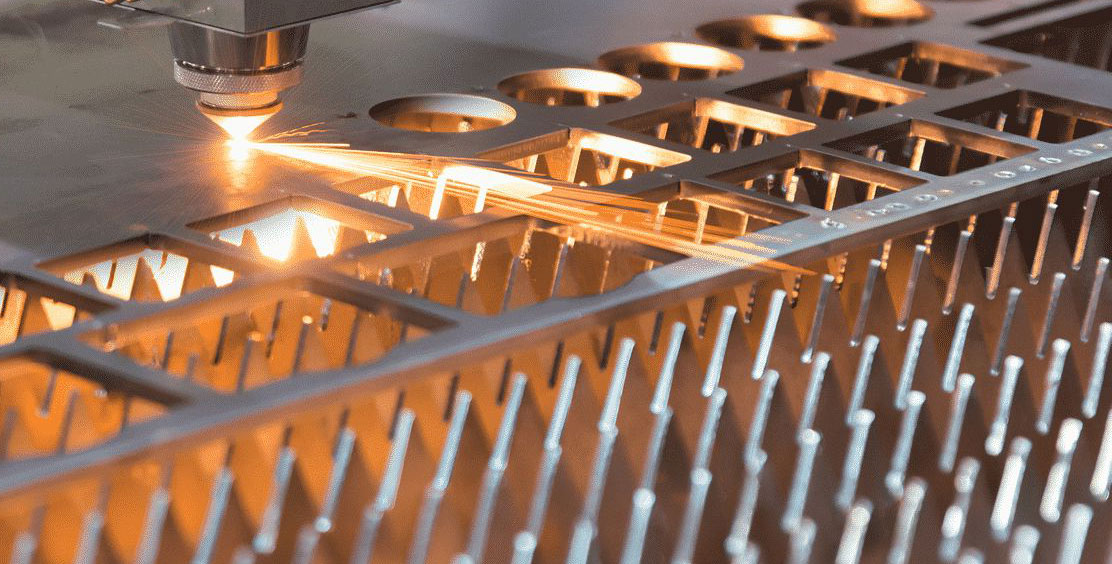
Fibre laser cutting uses energy far more efficiently than older CO₂ laser technology, and considerably more so than plasma cutting for sheet work. If your profiling process is still CO₂-based, upgrading to fibre is one of the most impactful single changes you can make; with the added benefit of faster cutting speeds and lower operating costs.
Servo-electric press brakes are the most visible example. A traditional hydraulic press brake runs its pump motor continuously, consuming 2–4 kW even when the machine is sitting idle between bends. A servo-electric machine draws power only when the ram is moving. Real-world data consistently shows energy savings of 50–80% compared to hydraulic equivalents. For a busy workshop running an 8-hour shift, that can translate to a reduction from around 60 kWh/day to under 15 kWh/day on a comparable tonnage machine.

The Morgan Rushworth XPE servo-electric press brake range, available through Bison, uses approximately 50% less energy than hydraulic machines of the same capacity, and as a bonus, runs significantly quieter and requires no hydraulic oil management.
3. Reduce Material Waste
Scrap metal represents embodied energy, the carbon cost of producing the material in the first place. Every kilogram of steel you send to the skip is wasted carbon as well as wasted money.
Efficient nesting software, which maximises the number of parts cut from each sheet, can reduce material waste dramatically. Modern fibre lasers with co-edge cutting and micro-joint nesting routinely achieve sheet utilisation figures that manual nesting simply can't match. If your operators are still nesting parts manually or with basic tools, this is a low-cost change with a direct impact on both scrap and raw material costs.
Precision in bending also matters, each rework or scrapped part has a carbon cost. CNC-controlled press brakes and folders reduce first-off failures and the material waste that goes with them.
4. Address Your Workshop's Energy Infrastructure
Before investing in new machinery, it's worth looking at the basics:
- LED lighting is a quick win. One UK fabricator reported saving £60,000 per year in energy costs after switching; equivalent to approximately 57,900 kg of CO₂e avoided annually.
- Compressed air leaks are endemic in most workshops. A regular leak audit and repair programme typically recovers 20–30% of compressed air energy with no capital investment.
- Switching off idle machinery sounds obvious, but machinery left running between jobs is one of the most common sources of unnecessary consumption.
4. Think About Your Supply Chain
For many fabrication businesses, the majority of their carbon footprint sits not in their own operations but in the steel they buy. Specifying steel produced via Electric Arc Furnace (EAF) routes, which uses recycled scrap rather than virgin ore, carries significantly lower embodied carbon than blast furnace steel. EAF production generates around 0.36 tonnes of CO₂ per tonne of steel, compared to around 2 tonnes per tonne for the conventional blast furnace route.
As more UK customers begin requesting carbon declarations for fabricated components, knowing the origin and production route of your steel will matter.
The Business Case
Sustainability and commercial performance are increasingly the same argument. Energy-efficient machinery reduces your electricity bills. Less material waste reduces raw material costs. Demonstrable environmental credentials open doors to customers, particularly in construction, infrastructure, and automotive supply chains, that are tightening their own sustainability requirements.
The businesses that treat decarbonisation as a cost centre will fall behind those that recognise it as a route to lower operating costs and stronger commercial positioning.
If you'd like to discuss energy-efficient machinery options for your workshop, the Bison team is happy to help. Call 01785 214242 or email sales@bisonmachinery.co.uk.
