Morgan Rushworth XPS 1300.36 Ball Screw Electric Press Brake 415V

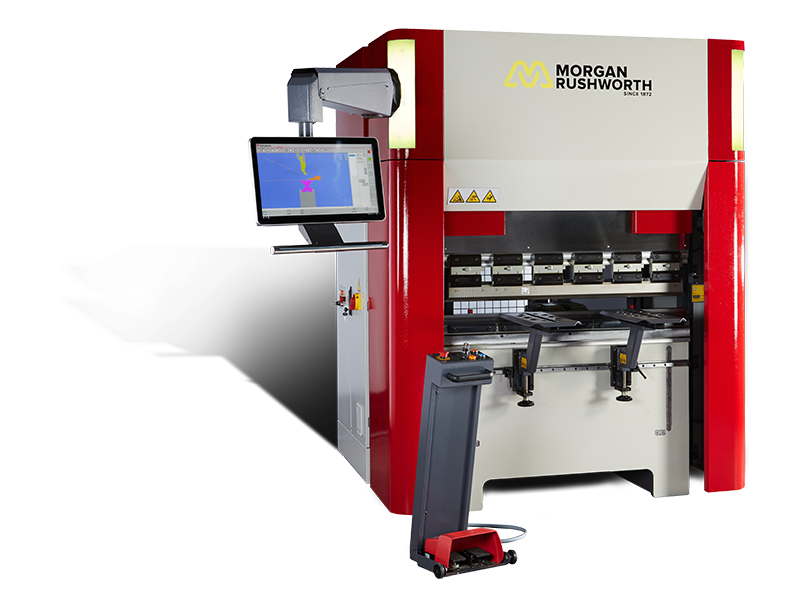
The Morgan Rushworth XPS ball screw servo electric press brakes are designed for high productivity and high repeatability bending. The servo driven ball screw design leads to extremely accurate high speed positioning of the bending beam. This 100% electric design results in lower energy usage, less servicing costs, less downtime and no hazardous waste, when compared to traditional hydraulic machines. The range includes two models, the 900mm x 20 tonne and a 1300mm x 36 tonne; these are ideal for high production work on small components. Both machines feature the advanced ESA VIS-875W 2D CNC touch screen control fitted on a height adjustable arm.

Morgan Rushworth XPS 1300.36 Ball Screw Electric Press Brake 415V
Download PDF Spec Sheet Morgan Rushworth XPS 1300.36 Ball Screw Electric Press Brake 415V Download PDF Spec Sheet

Download
PDF Spec Sheet

Read More Morgan Rushworth XPS 1300.36 Ball Screw Electric Press Brake 415V Read More

Read
More

Get In Touch Get In Touch

Get In
Touch

Features

  • ESA VIS-875W 2D CNC multi-axis CNC control with numerical and 2D graphical programming and 2D or 3D visualisation
  • Control mounted on a height adjustable arm
  • Fully synchronised CNC control of left and right upper beam cylinder position – Y1 + Y2 axis
  • CNC control of back gauge depth – X axis
  • CNC control of back gauge height – R axis
  • AKAS laser tooling guards for enhanced ease of use
  • High approach and return speeds for production bending
  • Front support arms with brush table, adjustable on a linear rail
  • Approximately 50% less energy use compared with hydraulic machines
  • Approximately 30% faster cycle times
  • Approximately 75% less servicing costs than hydraulic machines
  • Green technology – no oil or hazardous waste affecting the environment

Options

  • Manual bottom tool crowning system with position counter
  • CNC bottom tool crowning system
  • Quick release top tool clamping system
  • Front table instead of support arms
  • Hydraulic top and bottom tool clamping system
  • Offline ESA Bend 3D Software with Control Viewer

Technical Information

MODEL   XPS 1300.36
Bending Power tonne 36
Bending Length (Over Tooling) mm 1300
Bending Length (Between Frames) mm 960
Y Axis Approach Speed mm/sec 150
Y Axis Bending Speed mm/sec 10
Y Axis Return Speed mm/sec 150
X Axis Travel mm 750
R Axis Travel mm 160
No of Back Gauge Fingers   2
No of Sheet Support Arms   2
Stroke mm 150
Daylight mm 430
Table Height mm 790
Motor Power kW 10
Nominal Power (excluding options) kW 20.7
Length mm 2050
Width mm 1700
Height mm 2350
Weight kg 4350
The Benefits of Fibre Laser Cutting Over Traditional Metal Cutting Methods

The Benefits of Fibre Laser Cutting Over Traditional Metal Cutting Methods

Discover the benefits of fibre laser cutting, compare more traditional cutting methods, and work out whether investing in a laser cutting machine makes sense for your business.

Read More

Read More
The Growing Demand for Custom Fabrication in Offsite Construction Projects

The Growing Demand for Custom Fabrication in Offsite Construction Projects

Offsite construction has moved past the “will it catch on?” stage. Modular units, panelised systems, pods and hybrid builds that mix factory-made components with traditional methods are now a normal part of how UK projects get delivered. For fabricators and manufacturers, that shift is creating a steady stream of work that doesn’t fit the standard catalogue.

Read More

Read More
Plate Rolling & How to Choose the Right Machine

Plate Rolling & How to Choose the Right Machine

Plate rolling may look like a straightforward processes until you're standing in front of the a machine that is unsuitable for the task. This guide cuts through the options so you can make the right choice for your specific operation.

Read More

Read More
Unlocking Efficiency & Precision: Why UK Manufacturers Are Moving to Tube Laser Cutting

Unlocking Efficiency & Precision: Why UK Manufacturers Are Moving to Tube Laser Cutting

In modern metal manufacturing, staying competitive requires balancing speed, precision, and operational efficiency. Traditional tube processing methods, such as sawing, drilling, punching, and manual deburring, are notoriously labor-intensive and prone to human error. Each additional handling stage introduces potential for delay, increased costs, and inconsistency.

Read More

Read More