

Which guillotine options would have the most impact on your productivity?
- 14-01-2020
- Peter Dawber
Choosing a guillotine can be a minefield in itself, added to which there are a wide range of options available for different tasks. Depending on your requirements these range from the merely ‘nice to have’ to being critical to getting the job done in a timely fashion. If you have decided to invest in a new powered guillotine, it is worth spending some time reviewing the available options to make sure it not only performs the basic function but actually makes your production more efficient.
So what are the most common options and what do they do for you?
Short of time? Click here to read our top tips below.....
Powered Back Gauge Travel
The standard back gauge travel on a metal cutting guillotine is often around 600 to 750mm. If you want to cut longer than this then you will need to either gauge from the front, cut to a line with the back gauge swung away, or increase the stroke of the back gauge. Many machines can be optionally extended to 1000mm. Consider, what is the longest length you regularly cut?
Powered Blade Gap Adjustment
On a guillotine shear the blade gap needs to be set for the thickness of material you are cutting. This is typically adjusted manually but can also be calculated by the control and set using a motorised system. Cutting material on the wrong setting can result in damage to the blades. Think about whether your operators will always manually adjust the setting or should they be trained to enter the material thickness into the control and let the machine do the rest?
Pneumatic Sheet Supports
This is a really important point to consider if you are cutting sheet metal especially 2mm and below. When gauging more than around 100-200mm, thin material will drop down under its own weight before meeting the back gauge bar, making it impossible to use. Pneumatic sheet supports act as a support table for the material until gauging has been completed before dropping drop down out of the way to allow the material fall away freely.
Angle Gauge
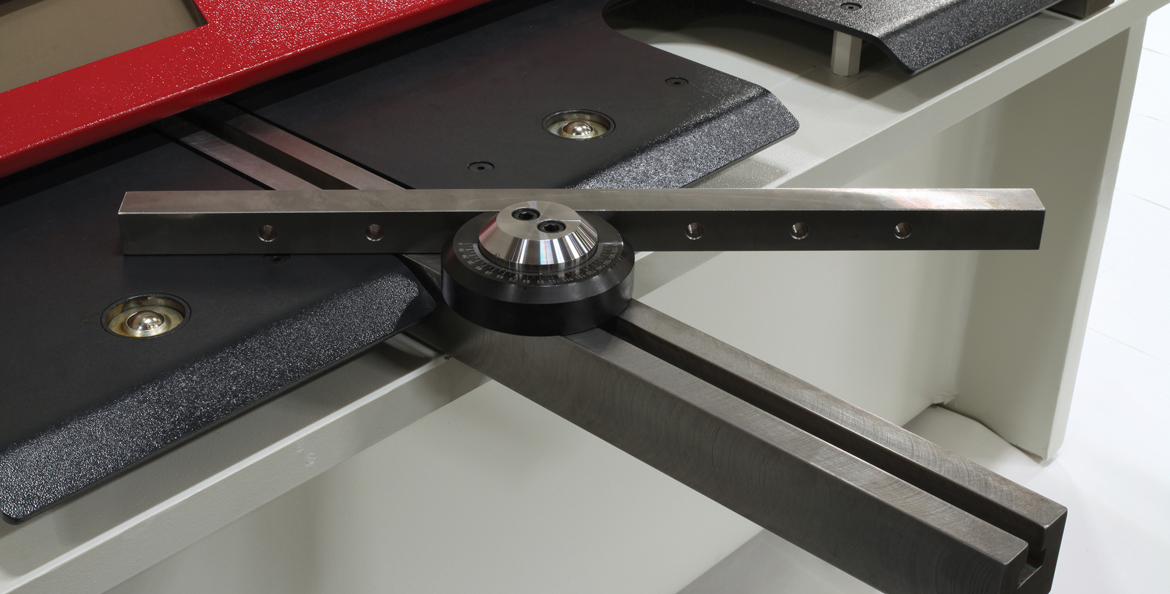
This is not quite such a common option but if you are regularly cutting material at an angle this can be very useful. The gauge fits to the guillotine squaring arm and can be easily set at an angle relative to the blade allowing quick repetitive cutting.
Squaring and Support Arm Upgrades
Another important consideration depending on the blank size you are working with. Longer squaring and support arms are normally available, typically increasing to 2 or 3 metres complete with support legs. This helps support thin or heavy material but, when fitted with tee slots and flip stops, can also be used to gauge from the front of the guillotine, either square to the blade or at an angle.
Laser Cutting Line
Most guillotine shears include a shadow line as standard equipment, allowing you to cut to a line. This isn’t always easy to see on some materials, so it is worth considering a laser cutting line which shows a highly visible red line at the shearing point. You will generally need to cut to a line if you are cutting an irregular shape or trimming out of parallel to the blade.
Top Tips
- Cutting material below 2mm at lengths over 200mm? Seriously consider a pneumatic sheet support.
- Constantly changing material thickness? You would be much better off with powered blade gap adjustment.
- Need to make cuts over 750mm in the middle of a sheet? You probably need longer back gauge travel.
- Always cutting to a mark or at an angle? Look at a laser cutting line and/or an angle gauge.
- Handing awkward or heavy sheets? Think about longer sheet supports and squaring arm
Not chosen a guillotine yet? Take a step back and read our article on choosing a guillotine.
Need help? Give us a call on 01785 336732 or drop us a line to sales@bisonmachinery.co.uk. Otherwise click here for our contact page.
