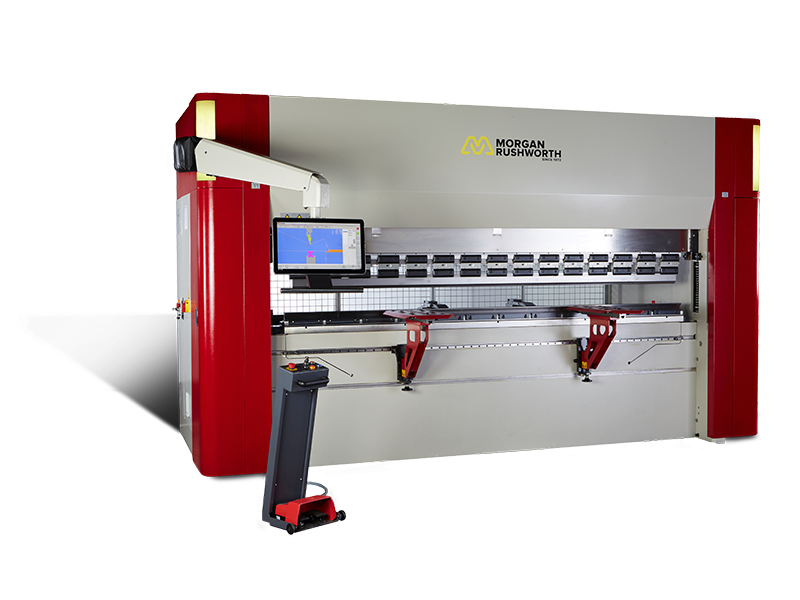
Morgan Rushworth XPE 3100.100 Servo Electric Press Brake 415V

The Morgan Rushworth XPE range of servo electric pressbrakes are designed with a belt and pulley system providing low energy useage, high bending cycle times and high accuracy. The range spans from 1530mm x 40T machines up to 3100mm x 100T, with all models equipped with the ESA VIS-875W 2D CNC touch screen controller. The combination of consistent pressure across the beam from the pulley system, high positioning accuracy of 0.01mm and the O frame design with virtually no flex results in a level of accuracy far higher than in conventional hydraulic machines. The side frames are fitted at each end of the machine meaning that the backgauge can be used for the full width of the machine to the maximum depth. The XPE Servo electric pressbrakes are far more reliable than hydraulic machines with no rams, seals, pumps, pipes etc resulting in less down time.

Morgan Rushworth XPE 3100.100 Servo Electric Press Brake 415V
Download PDF Spec Sheet Morgan Rushworth XPE 3100.100 Servo Electric Press Brake 415V Download PDF Spec Sheet

Download
PDF Spec Sheet

Read More Morgan Rushworth XPE 3100.100 Servo Electric Press Brake 415V Read More

Read
More

Get In Touch Get In Touch

Get In
Touch

Features

  • Approximately 50% less energy use compared with hydraulic machines
  • Approximately 30% faster cycle times
  • Approximately 75% less servicing costs than hydraulic machines
  • Green technology – no oil or hazardous waste affecting the environment
  • Even pressure across the bending beam negates requirement for crowning systems
  • frame design results in minimum distortion
  • Almost noiseless operation
  • X and R axis backgauge
  • ESA VIS-875W 2D CNC touch screen controller
  • Offline programming functionality on office PC

Options

  • Multi axis backguages
  • Hydraulic tool clamping
  • Laser angle measuring system
  • Sheet follower support arms
  • Optional off line ESA Bend 3D Software with Control Viewer

Technical Information

MODEL   XPE 3100.100
Bending Power tonne 100
Bending Length mm 3050
Y Axis Approach Speed mm/sec 75
Y Axis Bending Speed mm/sec 10
Y Axis Return Speed mm/sec 75
X Axis Travel mm 750
R Axis Travel mm 160
No of Back Gauge Fingers   2
No of Sheet Support Arms   2
Stroke mm 240
Daylight mm 505
Motor Power kW 2 x 5.5
Nominal Power (excluding options) kW 20.7
Length mm 4350
Width mm 1850
Height mm 2525
Weight kg 7200
Bison Machinery Expands Offering With The Full Davi Range

Bison Machinery Expands Offering With The Full Davi Range

At Bison Machinery, we are committed to providing our customers with the most advanced and reliable fabrication equipment on the market. That’s why we’re excited to announce the launch of the full range of Davi machines, now available directly through our team in the UK.

Read More

Read More
General Fabrication: An Overview of Machinery and Methods

General Fabrication: An Overview of Machinery and Methods

General fabrication is the foundation of countless industries – structural steel, mechanical engineering, plant maintenance, vehicle production and artisan metalwork to name just a few. From clean drilling to controlled bending, from rugged sawing to precise finishing, every step of the fabrication process is shaped by the quality of the equipment used.

Read More

Read More
Is British Steel Making a Comeback? The Future of UK Metal Production

Is British Steel Making a Comeback? The Future of UK Metal Production

Steel has long been the backbone of industrial Britain; a nation forged in the heat of its foundries and factories stoked by British coal. At its peak, the UK was one of the world's leading steel producers, with towns like Sheffield and Port Talbot synonymous with iron and steel production.

Read More

Read More
Which type of metal guillotine is best for your fabrication workshop?

Which type of metal guillotine is best for your fabrication workshop?

A metal cutting guillotine? A guillotine shear? A sheet metal shear? A power shear? Known by many names these machines shear carbon and non-ferrous metals by means of a pair of blades set one above another, with either a fixed or adjustable blade gap, and driven mechanically, pneumatically or hydraulically.

Read More

Read More